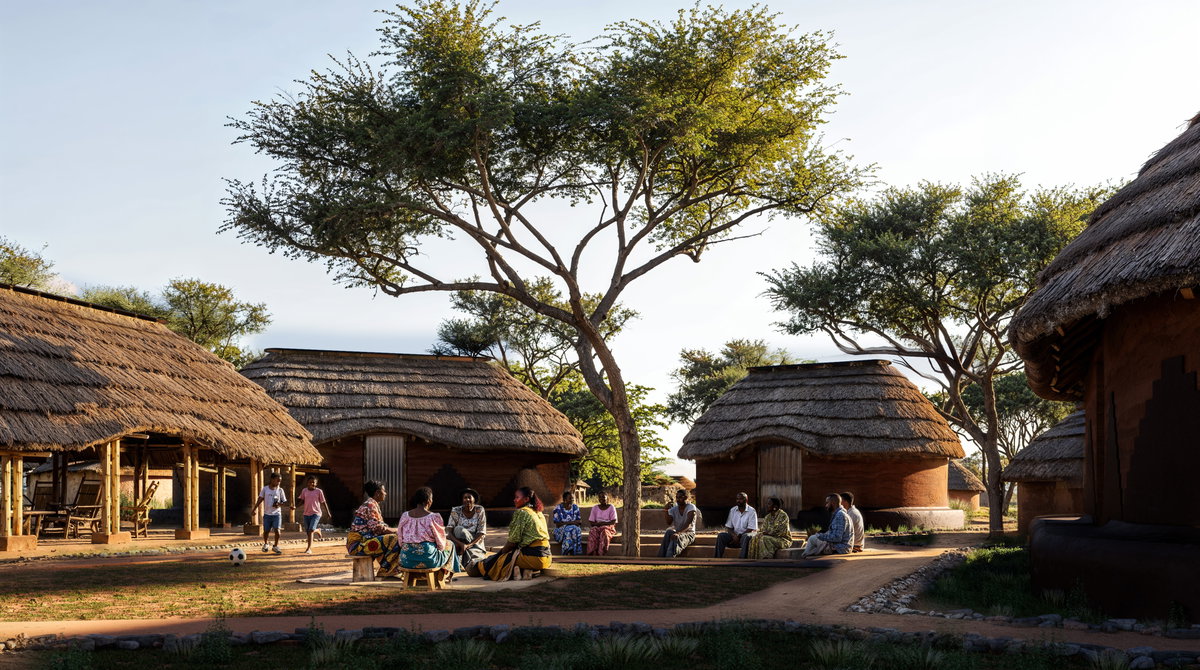
Driven by to.org’s ambition to explore how refugee settlements can evolve from temporary camps into places that better support communities over the longer term, BIG and to.org propose a comprehensive urban plan for Bidi Bidi in northern Uganda. Home to roughly 230,000 refugees today, the settlement continues to expand, with the proposed plan designed to accommodate an additional 155,000 residents while connecting Zones 1 and 2. The masterplan is defined by a repeating, nested urban structure, where a 250-m² family plot grows into a six-plot compound, then a cluster, neighborhood, and centre, each organized around shared spaces for gathering, trade, and everyday life. Informed by research visits to Kakuma and Bidi Bidi in 2025, as well as the expertise of LocalWorks, the proposal draws on local materials, construction methods, and existing housing typologies, while bringing together housing, public space, education, healthcare, infrastructure, and opportunities for work and production. “If the average stay in refugee camps is around two decades, then the term temporary cannot be said to suffice. If we start thinking of cities rather than camps, then charity becomes investments into the future, and if companies can be incentivized to locate their production in refugee cities, then the refugees can be given economic opportunities that they currently long for. We have attempted to design a scalable, phaseable, modular blueprint for a new way to accommodate the global flow of refugees.” – Bjarke Ingels, Founder & Creative Director, BIG